
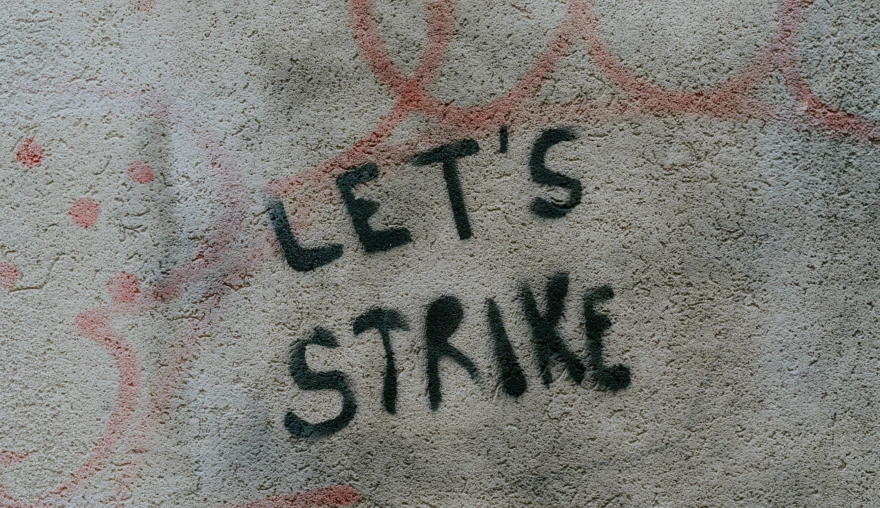
Right to strike protected by international law

It is rare for the International Court of Justice to consider a labour law issue. But in May 2026, it did just that – and the answer matters far beyond the courtroom.
Is the right to strike protected by ILO Convention 87? The International Court of Justice (ICJ) released an Advisory Opinion about the international right to strike. The word ‘strike’ is not mentioned in that Convention. The Convention, adopted in 1948 and currently ratified by 157 of the ILO's 187 member states, protects freedom of association for workers and employers. It guarantees the right ‘to organise their activities’, it does not mention the word ‘strike’.
The ILO is the agency of the United Nations that deals with ‘work’. Unlike the UN it has a tripartite composition: workers, employers and governments. The question submitted to the ICJ was deceptively simple: is the right to strike protected by the ILO Convention 87?
ILO Supervisory Mechanism
That silence on the word ‘strike’ had not been a problem for many decades. The ILO’s internal supervisory bodies, the independent Committee of Experts and the tripartite Committee on Freedom of Association (CFA), consistently interpreted the freedom to ‘organise their activities’ as implicitly including the right to strike. Over time, this reading was adopted by human rights courts across Europe the Americas and Africa. It became the dominant doctrine of international labour law.
Then in 2012, the ILO Employers’ Group spoke out against this long-standing consensus. Their argument was that the word 'strike' does not appear in the Convention, and there is no evidence it was intended to be included when the Convention was drafted. By objecting loudly and repeatedly to this interpretation they achieved something significant: they could now claim that ‘the ILO’ was divided on the matter. And this undermined the authority of an interpretation that had stood for 60 years.
Dispute presented to the ICJ
For 11 years, the ILO failed to resolve the dispute with internal discussions. Within the ILO it is common practice to overcome disputes by internal dialogue. Usually that has ultimately proven successful, but this time it was unsuccessful. In 2023, the ILO Workers' Group submitted a resolution to the Governing Body to refer the question to the ICJ for an Advisory Opinion. This is a non-binding but authoritative legal assessment. That resolution was passed, despite the objection of the Employers' Group and several member states.
The Court’s answer, delivered in May 2026, was unambiguous: yes, the right to strike is protected by Convention 87.
How the Court reasoned
The Opinion is a methodical piece of treaty interpretation, closely following the rules of the 1969 Vienna Convention on the Law of Treaties. It pays attention to the ‘Travaux Préparatoires’ (the preparatory documents that record the drafting process), and studies the interpretation given to it by the ILO supervisory committees. The Court examined the ordinary meaning of the words ‘to organize activities’, the context in which Convention 87 was adopted and from 1948.
It considered the longstanding interpretation of the ILO supervisory bodies. It noted that the right to strike is explicitly mentioned in Article 8 of the International Covenant on Economic, Social and Cultural Rights (1966), which is devoted to freedom of association. And it surveyed how regional human rights courts and supervisory committees across four continents have consistently treated ILO Convention 87 as the legal basis for the right to strike.
What it looks like in practice
The conclusion was clear but carefully defined. The Court confirmed that the right to strike is part of Convention 87. It said nothing about what that right looks like in practice – whether civil servants may strike, whether workers in essential services are covered, what restrictions are allowed.
These questions, which matter most in day-to-day legal practice, are decided upon by the CFA, as can be read in the ‘Compilation of CFA Decisions’. I expect that those CFA decisions will hold up firmly. They were made before 2012 in consensus with the three ILO partners. On top of that, in its Opinion the ICJ attached ‘great weight’ to the interpretations of the supervisory committees, an important support for the system.
What happens next
Though the Opinion is not legally binding, it does carry significant authority. An overwhelming majority of 10 out of the 14 judges voted for 'yes', only 4 voted 'no'. The ILO Governing Body, who requested it, meets in November 2026, and a response is expected then. Whether the Employers' Group will accept the Court's ruling, or continue to contest it within the ILO, remains to be seen.
Most probably a great majority of member states will argue that the dispute should be over now. In the proceedings before the ICJ 32 member states participated with oral and written statements. My advice would be: ILO, let it go, take advantage of the Opinion, and carry on. There is more than enough on your plate waiting to be dealt with.
Want to read more on the right to strike in international law? See this book.



0 Comments
Add a comment