
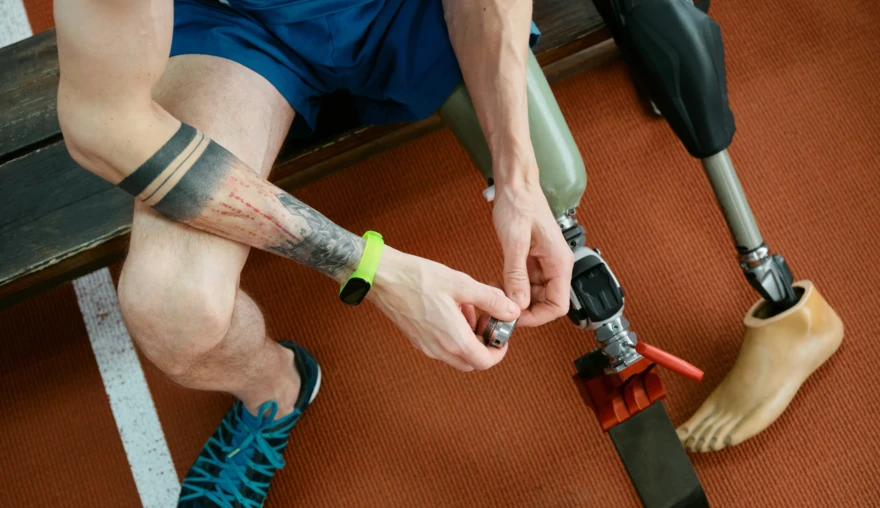
Who owns my amputated leg?


An amputated leg is neither a corpse nor a tradable ‘item’. What, then, is its legal status? And how does that status affect the way amputated limbs are treated once they leave the operating table?
These questions quite literally landed on our dinner table a few years ago when a friend proudly told us that earlier that afternoon he had amputated a leg for the first time. Just to be clear: our friend is a surgeon, and the operation was performed with the patient’s consent. Uninterested in the technical details, we asked what had happened to the amputated leg, and whether the patient could have taken it home.
Consent, amputation, and disposal
As the French philosopher Maurice Merleau-Ponty argued in his Phenomenology of Perception (1945), the human body occupies an irreducibly ambiguous position: it is simultaneously something we have and something we are. This ambiguity becomes painfully concrete once a body part is amputated. While much is known – both nationally and internationally – about organ donation and the treatment of corpses, the legal status of amputated body parts remains remarkably unsettled. Lawyers have long disagreed about how such parts should be classified.
Amputation is typically a last resort, preceded by a series of treatments. Most amputations are planned, allowing physicians to discuss necessity, risks, alternatives, and the consequences of not amputating. This process culminates in an ‘informed consent’ by the patient, which shields the physician from prosecution for grievous bodily harm.
But what happens after the operation? We asked hospitals directly. In practice, an amputated leg is usually discarded. It is classified as ‘specific hospital waste’ and transported – along with syringes, scalpels, blood-soaked bandages, and IV bags – in sealed containers to a central waste-processing facility in Dordrecht. There, the limb is incinerated.
What is striking is that no consent is sought from the patient for this disposal. This is remarkable, because alternatives do exist. We contacted funeral directors to ask whether detached body parts are ever buried or cremated. While rare, it does happen. We obtained invoices for the cremation of an adult leg amputated below the knee, with costs ranging from roughly 100 to 600 euros, depending on the arrangements. The option is exceptional, but undeniably possible.
In a second inquiry, we asked staff members of surgical departments how they understood the status of an amputated leg. Does it belong to the patient or to the hospital? And if it belongs to the patient, is the patient allowed to take it home?
Our findings revealed striking uncertainty. Certain removed body parts – such as kidney stones or gallstones – are routinely returned to patients. But the views on whether an amputated leg belongs to the patient, and whether a patient may reclaim it, varied widely. The absence of a uniform policy became clear following the well-known case of Leo Bonten.
Legal status and patient claims
Bonten had asked Erasmus University Medical Center whether he could take his amputated leg home after surgery. The hospital refused and even postponed the operation as a result. Forced to improvise, Bonten decided to donate his leg to science, with the explicit intention of retrieving it later. He eventually succeeded. The leg was returned from a forensic expertise centre, carefully preserved in a tank, complete with skin and flesh. A socket was added, and the leg was transformed into an elegant lamp.
As jurists, we are preoccupied with the legal status of such cases. Our conclusion was straightforward: Bonten had a full right to his leg – and therefore to his lamp. There were simply no legal grounds to deny him possession. On the contrary, the principle of informed consent implies that physicians should actively ask patients what they wish to do with amputated body parts. Failing to do so could plausibly give rise to a claim for damages.
Patients have rights over amputated or removed body parts under property law, health law, and human rights law. These rights are not merely abstract. On top of that, the ability to consider in advance and decide what will happen to a body part supports psychological preparation and the eventual process of grieving. Patients may have sound and legitimate reasons for wishing to bury, cremate, preserve, or otherwise use a body part that was once integrally theirs.
This became clear to us again when a law student from Leiden University contacted us. She was facing extremely invasive brain surgery during which part of her skull would be removed. She wanted that piece returned to her afterwards. The physician initially refused to agree to this arrangement in advance. Her response was firm: no skull piece, no operation.
Some time later, we received a photograph. At the formal gala of her student association, she wore the removed piece of skull as a chic necklace to set off her evening dress. She looked radiant. By all accounts, she had the night of her life.






0 Comments
Add a comment