
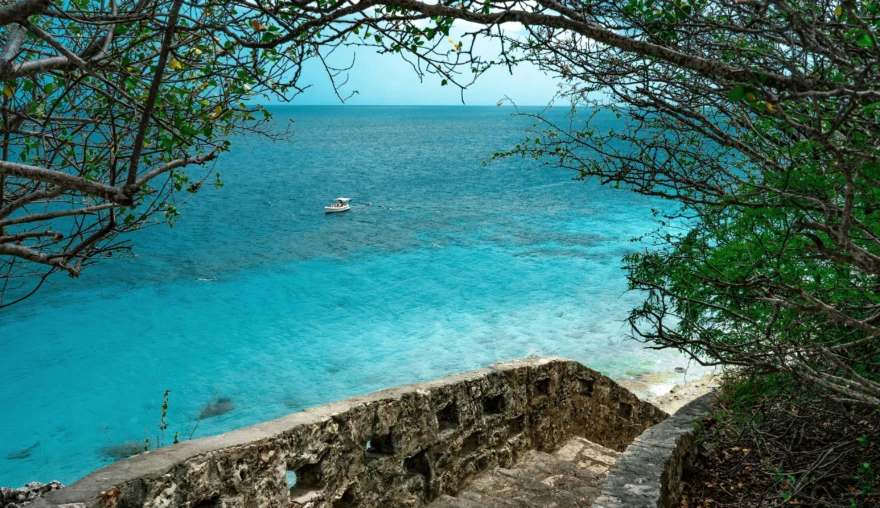
Climate duties across the Kingdom

When climate protection stops at Europe, what remains of equal citizenship? The Bonaire case challenges how far the Dutch State’s human rights obligations truly extend.
On 7 and 8 October 2025, Greenpeace Netherlands faced the Dutch State in court in a landmark climate case concerning Bonaire.
The plaintiffs argued that the Netherlands is failing to protect Bonaire from the worsening impacts of climate change. Bonaire’s status as a special municipality within the Kingdom of the Netherlands has not translated into equal levels of climate adaptation, infrastructural investment, or risk mitigation compared to municipalities in the European Netherlands. This raises a central question: can a state fulfil its obligations under international and human rights law while adequately protecting only parts of its population?
The State's position
The Dutch State does not deny that Bonaire faces climate risks. It argued, however, that appropriate measures are already being taken and that the responsibility for adaptation also lies with Bonaire’s local government (Openbaar Lichaam Bonaire). The State further emphasised that an adaptation plan was being developed that includes the Caribbean Netherlands. At the same time, it maintains that climate policy is a political matter and that the Netherlands cannot be held individually responsible for a global problem.
A striking feature of this reasoning is that the State simultaneously recognises its responsibility to protect Bonaire while insisting that no human rights obligations have been breached, because there is no ‘real and immediate risk to life’ within the meaning of the European Convention on Human Rights (ECHR). It also stresses that the European Netherlands lies largely below sea level and therefore requires more urgent attention. This framing treats vulnerability as a matter of geographic comparison rather than legal obligation. Human rights protection does not follow a zero-sum logic in which protecting one part of a state is understood to come at the expense of another.
A hierarchy of protection
What becomes visible through the State’s argumentation is therefore not only a matter of legal interpretation, but also one of prioritisation. When risks on European soil are framed as more urgent than risks affecting Caribbean citizens, a hierarchy of protection emerges. In practice, this hierarchy reinforces historical inequalities between the European and the Caribbean parts of the Dutch Kingdom.
Bonaire’s scale makes this disproportionality particularly clear. The European Netherlands is nearly 150 times larger and possesses far greater (infrastructural) resources. A relatively small rise in sea level along Bonaire’s coastline may already result in permanent loss of habitable land, destruction of cultural and ecological sites, and displacement of communities. The harm is therefore not measured only in square metres, but in the erosion of social and cultural fabric.
A judicial turning point
On 28 January 2026, the District Court of The Hague confirmed the core concerns underlying this case. Using the KlimaSeniorinnen framework of the European Court of Human Rights, the District Court assessed the State’s conduct by examining three connected obligations: mitigation, adaptation, and procedural safeguards.
While the Court found no violation of the right to life (Article 2 ECHR) due to the absence of an acute threat to life, it did find that the State violated its positive obligations under Article 8 ECHR (the right to respect for private and family life). The Court emphasised that climate change threatens long-term living conditions, health, and the ability of the inhabitants of Bonaire to enjoy their private life and culture. It further rejected the argument that geographical differences or internal governance arrangements could justify delayed protection, stressing that the State remains ultimately responsible for the overall level of protection within its territory.
The Court further held that the State violated the prohibition of discrimination under Article 14 ECHR (non-discrimination in the enjoyment of Convention rights) and Article 1 of Protocol No. 12 (general prohibition of discrimination). Despite longstanding knowledge that Bonaire would be affected earlier and perhaps more severely by climate change, measures for the island were taken later and less systematically than for the European Netherlands.
Importantly, the judgment also clarifies that effective climate protection is not only about outcomes, but about process. As part of the required procedural safeguards, the Court highlighted the importance of access to information and meaningful participation in decision-making. For Bonaire, this means that climate adaptation cannot be designed solely in The Hague but should include those affected.
Equality in practice
This case forces the Dutch State to confront whether equal citizenship within the Kingdom has substantive meaning. Equality cannot be selectively applied across geographic borders, particularly when constitutional unity is invoked for political legitimacy. If climate protection is prioritised for the European Netherlands and postponed for the Caribbean Netherlands, inclusion becomes conditional rather than inherent. If a state claims to protect its population as a whole, that protection must extend across the entire kingdom.
The Netherlands, therefore, cannot meet its international obligations while part of its population remains disproportionately exposed. Meaningful equality requires urgent and inclusive adaptation measures for Bonaire, tailored to its specific vulnerabilities.
This blog was written as part of the Sustainability & Law lecture series 2025.





0 Comments
Add a comment