
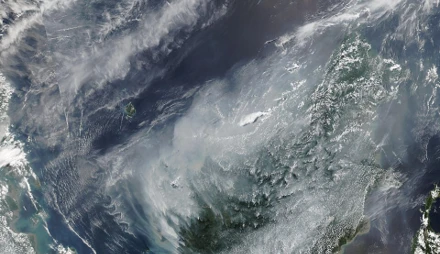
Haze: a burning issue for ASEAN

As transboundary haze from Indonesian wildfires sweeps over neighbouring Malaysia and Singapore, polluting the air and raising health concerns, ASEAN is called upon to step up and take action.
From August into October, parts of Southeast Asia have faced severe air pollution forcing authorities to declare emergencies and take measures against the hazardous smoke.
A recurring crisis
The pollution comes from fires in Indonesia’s Sumatra and Kalimantan regions, carried by monsoon winds across the border into neighbouring Malaysia, Singapore, and Brunei: a so-called transboundary haze. Most of these fires are deliberately started to clear tropical forest for agriculture. This is illegal under Indonesian law, but enforcement is weak.
The region has been experiencing this type of pollution crisis regularly since the late 1990s; in recent years it has become an annual occurrence. Exposure to the polluted air increases the risk of lung cancer, cardiovascular disease, and other adverse health effects.
With millions across the region affected by the haze, there have been growing calls for a stronger and more comprehensive approach to the issue through regional cooperation. On September 8, the Malaysian Prime Minister Anwar Ibrahim urged the Association of Southeast Asian Nations (ASEAN) to review and improve its existing mechanisms for addressing transboundary haze to prevent future instances.
Room for improvement?
This raises two questions: what mechanisms are currently in place, and how could the implementation be improved? Born out of the 1997 Southeast Asian haze crisis, the ASEAN Agreement on Transboundary Haze Pollution (AATHP) was signed in 2002 by the regional organisation’s member states. Indonesia, the main source of the haze, only ratified it in 2014. The AATHP provides the framework for multilateral cooperation on addressing transboundary haze pollution and binds signatories to cooperate and undertake various measures in support of that objective.
The implementation of the AATHP must be understood in relation to ASEAN’s principle of non-interference, the so-called ASEAN Way. How might a cooperation-based framework operate in a regional order built on non-interference? Although the AATHP is legally binding, its core obligation is to cooperate; it leaves states considerable discretion in implementation, and lacks enforcement mechanisms. These features can be read as a compromise that allows such a framework to function within ASEAN.
Current laws in place
One category of preventive measures is that of legislative acts, as listed under Article 9(a), (b), and (g) [LB3] of the AATHP. Singapore was the first ASEAN member state to introduce anti-haze legislation: the Transboundary Haze Pollution Act 2014, which creates criminal and civil liability for companies whose conduct abroad causes or contributes to haze pollution in Singapore. Malaysia planned similar legislation, but these plans were postponed in 2020, and, after being only briefly brought up again by the country’s natural resources minister, were formally dropped in 2023.
The ongoing crisis may provide the impetus for PM Anwar’s cabinet to revive these plans and bring a Malaysian anti-haze law to fruition. If Indonesia followed suit, a harmonised regional framework could emerge, allowing a more uniform and effective approach to perpetrators.
Possible alternatives for improvement
In addition to criminalising conduct that is responsible for haze pollution, another option could be for ASEAN to agree to impose trade restrictions on goods produced in high-risk areas, an agreement that can be formulated and adopted as a protocol based on Article 21(1) AATHP. Such a punitive measure, however, may not find consensus among ASEAN members, and would likely need to be justified under Article XX of the General Agreement on Tariffs and Trade (GATT).
A less coercive alternative would be the promotion of a region-wide sustainability certification scheme for palm oil and timber products, similar to the promotion of markets for biomass as mentioned in Article 16(1)(g) AATHP. Such schemes exist, but they are fragmented: national schemes such as Malaysia’s MSPO, and Indonesian ISPO operate alongside the international RSPO. Harmonising these instruments could lay the foundation for an ASEAN-wide scheme.
Lastly, financial incentives to reward good conduct can also be used as a preventive measure. Through subsidies, companies and farmers can be assisted in adopting practices that reduce forest degradation and improve land management. To this end, resources could be drawn from the ASEAN Transboundary Haze Pollution Control Fund, as established in Article 20 AATHP.
Balancing act
Addressing the root causes of haze pollution requires a combination of measures, from legislation and trade measures to certification and financial incentives, while respecting ASEAN’s principle of non-interference and member states’ sovereignty.
Whether through subsidies or trade restrictions, investing in haze prevention today would save costs in the long term, from cloud-seeding operations to alleviate the haze to the healthcare costs of treating diseases and other complications caused by haze exposure. As the saying goes, prevention is better than cure.




0 Comments
Add a comment