
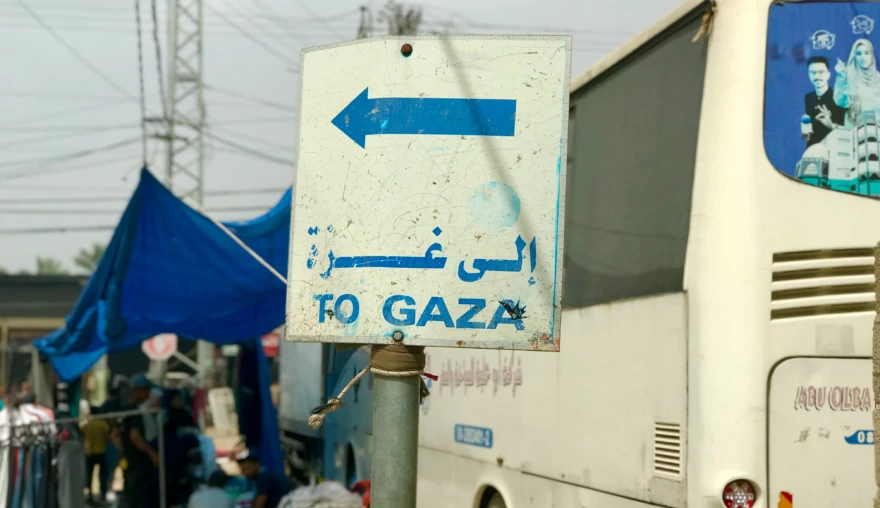
Palestine's right to the sea

In 2024, the International Court of Justice found Israel’s presence in the Occupied Palestinian Territory unlawful but said nothing about the sea. What are Palestine’s maritime entitlements, and does the ruling reach its waters too?
On 19 July 2024, the International Court of Justice (ICJ) issued a long-awaited Advisory Opinion on the ‘Legal Consequences Arising from the Policies and Practices of Israel in the Occupied Palestinian Territory’. By way of General Assembly Resolution 77/247, the Court was asked to evaluate the legal consequences of Israel’s prolonged occupation, settlement and annexation of the Occupied Palestinian Territory, including its effects on the legal status of the occupation and the resulting obligations for the UN and its Member States.
In what is now settled law, the Court deemed Israel’s presence ‘unlawful’ and in breach of its obligation ‘to respect the right of the Palestinian people to self-determination’. Building on this finding, this blogpost argues that the Court’s reasoning was limited and fills an analytical gap by extending its reasoning to a domain left entirely unexamined: the law of the sea. In short, I argue that Israel’s violations have historically extended to Palestine’s maritime entitlements, constituting yet another violation of the Palestinian people’s permanent sovereignty over natural resources and, by extension, Palestinian self-determination.
Palestine's maritime entitlements
Palestine has been party to UNCLOS since 2015 and defined its maritime boundaries in 2019. It therefore enjoys the status of a coastal State and its associated zonal privileges: sovereignty over its territorial sea (Article 2); sovereign rights across its exclusive economic zone (Article 56); and sovereign rights to explore resources on its continental shelf (Articles 77 and 81).
The letter of the law leaves little room for ambiguity. Yet, Israel’s non-party status raises a separate question: can UNCLOS bind a State that never signed it? The answer lies in customary law. As the 1969 North Sea Continental Shelf, the 1985 Continental Shelf, and the 2012 Territorial and Maritime Dispute cases established, these entitlements possess a customary status (they apply to all States regardless of treaty membership). Israel is therefore bound by them regardless.

‘Sovereign rights’
As the Court reasoned, the occupation is unlawful and irrelevant to the above conclusion. Any claim Israel might assert over Palestine’s maritime resources or zones fails on two separate grounds. First, the law of occupation limits the title of an occupying State to that of ‘administrator’ and ‘usufructuary’; it does not transfer sovereignty or territorial rights. Second, the concept of sovereign rights is not equal to sovereignty, and UNCLOS limits coastal States to the exercise of the former, not the latter, beyond their territorial sea.
Areas beyond the 12-nautical-mile-limit are not considered part of a state’s territory. Consequently, an occupying power’s temporary authority over land is not enough. Article 77(3) UNCLOS confirms this directly: a coastal State’s sovereign rights are exclusive and independent of occupation or express proclamation. Any Israeli exercise of coastal authority over Palestine’s maritime zones is therefore unlawful from the outset and nothing short of usurpation.
Gaza’s fisheries
Gaza’s fisheries provide the clearest illustration. Since 1967, Israel has maintained a maritime blockade along the Mediterranean coast and dictated all activity within – from permit systems and fishing limits to equipment regulation. As several UN reports have documented, the arbitrary and shifting enforcement of these measures has produced a chronic unpredictability for an estimated 18,000 Palestinians who depend on the fishing industry. Given how crucial this sector is to local livelihoods and food security, these restrictions – often enforced with lethal force – have fed directly into the risk of famine. As such, they threaten not only a source of income and nutrition, but Palestinian survival itself.
The humanitarian toll is severe, and the legal implications are equally serious. International law dictates that Palestine alone holds the authority to exploit, conserve and manage its maritime resources. As such, Palestine alone should determine the allowable catch, conservation measures, and third-party access to its maritime zones and resources. The management of fisheries is more than an economic entitlement; it is a form of sovereign governance. Thus, by maintaining a naval blockade, Israel unlawfully exercises coastal authority it does not possess, amounting to another obstruction to Palestinian self-determination. Appropriation and displacement are two sides of the same coin, and the violation here lies not in exploitation, but in dispossession.
Permanent sovereignty over natural resources
To the extent that Palestine possesses a right to self-determination, the Palestinian people also hold a permanent right to their natural resources – at sea and on land. On 19 July 2024, the ICJ reaffirmed this, but stopped at the shoreline, concealing the full extent of Israel’s occupation.
The law of the sea has often been absent from these discussions but, as this blogpost highlights, UNCLOS can offer new ways of analysing the boundaries of sovereignty and a people’s right to self-determination. Full responsibility demands full accountability. Therefore, this is more than an academic exercise, but a necessary revision to an incomplete account of occupation.





2 Comments
Hereby link, for reaching the report itself:
https://digitallibrary.un.org/record/720841?v=pdf
Interesting post.
Just worth noting, that it is not so simple as an apple. This is because of Palmer report and its findings that that siege or naval blockade of Gaza, is legal under international law.
Here for example, titled:
UN Palmer report: blockade of Gaza legal
Here:
https://www.abc.net.au/news/2011-09-07/mittelman-un-palmer-report-blockade-of-gaza-legal/2875308
Thanks
Add a comment