
The international order in crisis?

President Trump’s proposed Board of Peace raises questions on the future of the United Nations and international order. What can historical developments of international law tell us about its future?
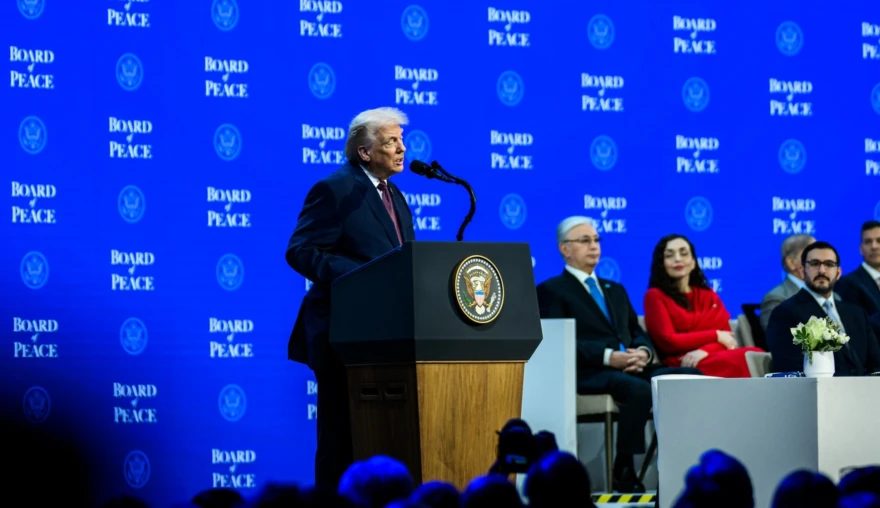
In late January 2026, U.S. President Donald Trump oversaw the signing ceremony of his so-called ‘Board of Peace’ (BoP). According to its charter, the new international organisation aims to promote stability, uphold lawful governance, and secure peace across the globe. Commentators have pointed out that the initiative may be a bold attempt to supersede the United Nations (UN). Its mission is identical to that of the UN’s principal task of peacekeeping. Particularly given its stated ambition: 'to depart from approaches and institutions that have too often failed'.
Whether the Board of Peace will develop into a meaningful actor in international affairs remains uncertain. Nevertheless, its founding has fuelled broader debates on the UN's efficacy.
Today’s zeitgeist suggests that the increasingly entropic world we live in is experiencing ‘unprecedented times’. Yet, when viewed from a historical perspective, today’s affairs fit within a pattern of historical recurrence. Specifically, periods of conflict and geopolitical turmoil occurring over the last few centuries in modern history. Examining this historical trajectory may offer valuable insight into the present moment.
The origins of international law
The 1648 Westphalian Peace is often credited as the foundation of modern international law. It established the principles of sovereign statehood and non-interference in foreign states’ domestic affairs. These principles remain central today and are still echoed by Article 2(4) of the UN Charter, prohibiting the threat or use of force against any state.
However, this milestone had only been achieved following the Thirty Years’ War, the massive conflict that ravaged Europe. And while it did not secure lasting peace, it marked a decisive transition of power from feudalism to a system centred on sovereign states.
Keeping the peace after conflict
A similar dynamic can be observed in the aftermath of the early 19th century’s Napoleonic Wars; another devastating conflict Europe would experience. At the 1815 Congress of Vienna, the great powers of Europe sought to establish lasting peace, to maintain the territorial and political balance of power between them. This became known as the Concert of Europe and the Congress System. The system entails the convening of the major powers whenever a dispute between states arose, to prevent conflict or at least minimise its scope through diplomacy.
This approach to disputes, which obliges states to refrain from the use of force and pursue diplomacy to settle disputes instead, is reminiscent of Article 2(3) in the UN Charter. The Congress System was generally successful at first, but lost coherence as decades passed, and with the outbreak of the First World War, this form of ‘peacekeeping’ ended.
Intergovernmental organisations in the 20th century
Determined to ensure that the ‘War to End All Wars’ would live up to its name, the major powers founded the League of Nations (LoN) at the 1920 Paris Peace Conference. The first of its kind, it was an intergovernmental organisation whose principal mission was to uphold peace, much like the Congress System before it and the UN after it. The LoN’s efficacy is debatable, but it failed to halt Axis aggression in the 1930s and ultimately preserve the peace of the international order at the onset of the Second World War.
Resolved to unite the world in a common mission of cooperation and peace, the Allied Powers founded the United Nations, in turn spawning an array of treaties and institutions that govern international relations and make up the rules-based order. Despite having long been recognised for being a champion of peace and development, the UN-led post-WWII order has been deteriorating; today more in disarray than ever.
Historical recurrence and the present moment
Looking across these episodes, a recurring pattern becomes visible: a major conflict disrupts the existing order, the major powers establish a new post-war order to maintain durable peace, over time these frameworks weaken, giving way to a period of uncertainty. This ‘interregnum period’ sees the gradual breakdown of this post-war order, allowing for the cycle to repeat as the breakdown spawns another, more destructive war.
If history provides us one insight, it is that crisis and uncertainty have served as catalysts to reshape the international legal order, refining these institutions into more effective instruments in the pursuit of peace. International law has evolved from the Congress System to the United Nations. Might the Board of Peace be the next step?



0 Comments
Add a comment