
The right to record – a catch-22?

The right to record police action is legally protected in the US. But how is that right guaranteed when the police themselves control its enforcement?
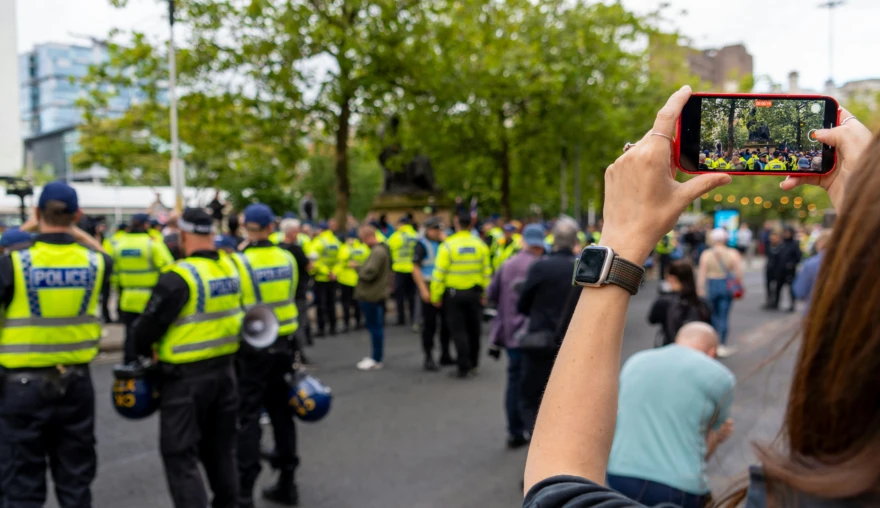
Recent Immigration and Customs Enforcement (ICE) deployments in the United States – notably in Minneapolis, Minnesota – have renewed attention to citizens filming law enforcement. Those who film police activity as a form of civic oversight are often classified as legal observers. While the right to record the police in the US is legally recognised, it is negotiated on the street in real time, in situations where police officers retain broad discretion to determine whether someone can, in fact, record a scene. Drawing on my current doctoral research on citizen recording of police action in New York City, I question whether the right to record can protect citizens when its enforcement is paradoxically shaped by police authority itself.
Who is a 'legal observer'?
In the wake of high-profile confrontations in Minneapolis, the term ‘legal observer’ has increasingly appeared in public discussions. In early January 2026, Renée Nicole Good, a Minneapolis resident said to have been monitoring an ICE raid, was fatally shot by an ICE agent. Two weeks later, Alex Pretti, an ICU nurse who was filming federal agents with his phone, was shot and killed by two US Customs and Border Protections (CBP) officers. These killings, covered extensively by the media and memorialised worldwide, have become potent reference points in debates about the presence and power of civilian observers. In response, many groups – including local protest networks and organisations such as the National Lawyers Guild – have hosted legal observation training sessions aimed, amongst other things, at empowering citizens to document state (mis)conduct. Yet, despite the growing visibility and perceived importance of legal observation, the legal basis for recording police activity and the limits of that protection remain contested.
Recognised, but not absolute
In the US, the right to record police officers performing their duties in public spaces has been widely recognised by federal courts as protected under the First Amendment. Although the Constitution does not explicitly mention the act of making a recording, numerous US Courts of Appeals have upheld that filming police activity constitutes a form of expressive conduct tied to freedoms of speech and press. In this sense, the right to record is understood as an established constitutional protection.
Several states and municipalities have sought to further clarify this right. In New York, for example, both state and local-level laws affirm that individuals may record officers performing their duties in public. However, the right to record is neither uniform nor absolute. The scope of protection afforded to citizen recording is shaped by context-dependent judgements about safety, order, and, most importantly, ‘interference’ with police activity. This tension is crucial. While legal doctrine recognises the existence of a right to record, the law leaves ample room for interpretation – a discretionary space in which officers may decide whether recording crosses the line from a lawful act to an unlawful one.
Discretion in action
The ambiguity of legislation on the right to record is further complicated by laws that regulate proximity to police officers. Known as buffer laws, these measures criminalise approaching within a specified distance of officers engaged in their official duties, after an order to step back has been given. While framed as necessary for officer safety and crowd control, such laws directly affect the ability of citizens to observe and record police activity.
Several of these laws have been challenged precisely because of the discretion they afford officers. In Indiana, for example, a 2023 buffer law made it a crime to approach within 25 feet (7.62 metres) of an officer after being told to stop. During oral arguments challenging the state, a judge asked whether an officer could invoke the law arbitrarily ‘because he had a bad breakfast’. The state attorney responded that such discretion would be permissible. The buffer law was later struck down by the US Court of Appeals for the Seventh Circuit, whose ruling underscored the risks posed by granting officers unfettered authority to determine when recording becomes interference. Similar statutes, which are being litigated in other jurisdictions, shift the focus from whether recording is protected to whether an officer deems it permissible in the moment, effectively rendering the right to record a conditional privilege.
The paradox of the right to record
These dynamics raise a deeper sociolegal concern. One function of the right to record the police is to document, and sometimes scrutinise, the exercise of police power. Yet, in practice, its protective force depends on how it is interpreted and enforced by the very actors it is meant to keep in check. Legal observers may be highly trained and visible, but neither their presence nor their knowledge of the law can protect them from discretionary judgements made by the officers they are observing. This gap between legal recognition and actual protection may be a matter of life or death, as evidenced by the tragedies currently unfolding across the US. So long as the right to record depends on police discretion, it remains a catch-22 – defined not so much by the law, but by its enforcement.



0 Comments
Add a comment